Restoration
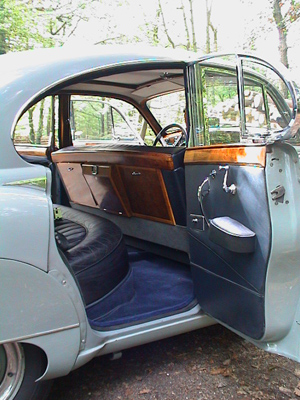 I had chosen a garage in the neighbouring town Steinbach im Taunus specialised in classic cars, who were to thoroughly check the car, repare it and "get it on the road". This is where I had also asked the MK IX to be delivered which proved to be a good decision since of course the motor did not start up immediately. The car was far from a "good driving condition", as Kruse had promised.
This way, the truth came out after all: not the transport company was "confused" but Chris Neuhouser from Kruse International or he owner had lied - either on purpose or not. To call a car which doesnīt drive "excellent" is really quite outrageous - a "good basis for restauration" would probably have been more to the point.
After a first check-up, the garageīs comment was: it could have been worse! (And there are those stories of Jaguar buyers who have jumped directly into the cold water of the harbour of Bremerhafen after setting eyes on their long awaited "cat" from the USA for the first time).
It was however nice to hear that nothing really grave turned up which was beyond repare. After a few days, the motor worked again. The garage then made a list of all the things that would have to be done in order to allow the car to pass the German TUEV and receive number plates (licensure).
The first estimate amounted to approx. 14.000 Euros (incl. a new electrical wiring harness and new tires), which really shocked me because it surpassed my expectations by far.
After going through the list in more detail, several discussions and cost comparisons with offers from other garages, we then brought down the amount to the absolute minimum necessary and finally arrived at a more sensible sum of 5.400 Euros, which finally went up again to above 8.000 Euros relatively quickly when we had to order some more spare parts.
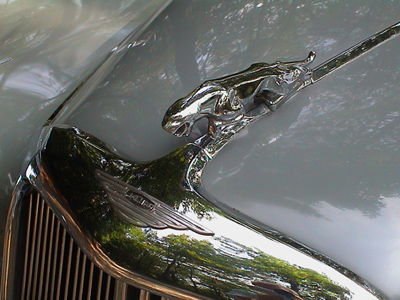
Due to security reasons, the plan was to replace all fluids: motor oil, gear box oil, differential gear oil, coolant, brake fluid, etc. And any leaking parts and filters were to be replaced as well. Furthermore, all air brake system pipes and brake discs (2 were still o.k., 2 new ones had to be ordered) and the hand brake needed to be taken care of as well as the complete gas pipeline including the tanks, which we finally cleaned and sealed ourselves because this was relatively easy to do.
Also, some welding was necessary to the underbody. Many plastic parts as well as parts of the steering linkage and the suspension were replaced. And finally, the motor needed a new valve cap because the old one had tears in it, having been screwed into the aluminium too tightly by an Amercican mechanic. As a final touch, the car was then greased in all the foreseen places.
That was the main main work done in the garage in Steinbach, which took over 2 months to perform, especially because the spare parts often took their time to arrive.
After that, the car paid a visit to the body shop in Neu-Isenburg, because there were rusty spots on the rear spats and the two rear doors as well as on one of the front fenders, for which metal was welded and varnished. These repairs took another four weeks and cost an additional 2.500 Euros.
However, unfortunately the varnisher was unable to 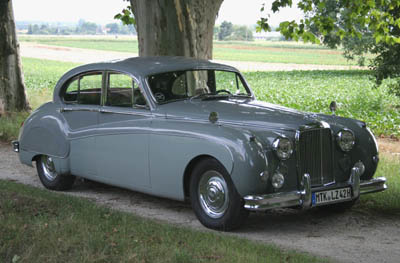 reproduce exactly the original colours, which means if you really look hard, you see a car with four colours instead of two. Well, at least there is no more rust, only a few little dents and scratches which are quite becoming to a 40-year-old car.
It had now become May 2004. Back in the garage in Steinbach, only a few more little details were to be taken care in preparation for the German TEUV, e.g. installing an warning light switch because these are prescribed by the TUEV. This proved however to be a major issue because the electrical wiring is poled just the other way around (positive earth) than our cars nowadays (negative earth) and there are no corresponding switches with "plus on mass" on the market (and the garage also didnīt find a satisfying solution).
Finally, I myself found a restorer in the north of Germany who had also received approval from the TUEV for an MK IX and who had built his own switch (reconstructing a current one) and asked him to send us an identical one which the garage could then build into the our MK IX.
Steering wheel lock (external), warning triangle and first aid box were quickly bought, then we could present our car to the TUEV for a full check and licensure according to § 21 c, the German procedure to get a 30 (minimum) year old car licenced as a "classic car" with a reduced car tax and the historical number plates ("H"-number plates).
Proceed to Licensure