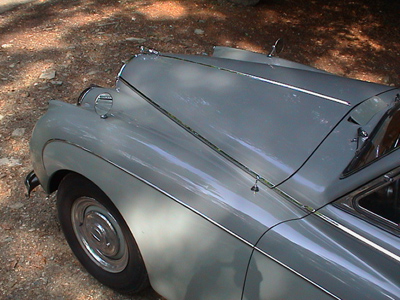
During all this time, I had always worried a little bit about the tires, because the white wall tires from Michelin in the US were neither licensed fort the European Union nor did they have a speed index and thus it is not really allowed to drive them here in Germany. Also Michelin Germany couldn´t give me further technical details regarding these tires, which are not being produced in France for export to the USA any more.
Alternatives for the MK IX are either the original Dunlop Road Speed cross ply tires 6.70 x 16 H or the radial tires with the measures 185/80 x 16 H (e.g. Vredestein Sprint Classic), both costing more than 240 Euros a piece. Cheaper alternatives left are VAN tires (195/75 R 16) or SUV tires (205/80 R16), which are however not optimal because they are a little bit tough and slippery when wet.
The managing director of the garage in Steinbach then drove the car to a TUEV engineer that he knew personally. There, our MK IX passed the inspection without any problems and received historical number plates (licensure). 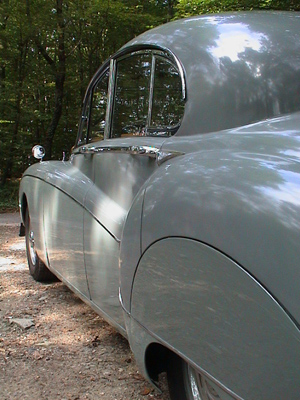
Even the white wall tires were accepted after some discussion, when the TUEV engineer was convinced that nobody would ever drive this car at a higher speed than 150 km/h, even if the official maximum speed is stated to be 180 km/h (according to Jaguar Germany) - all tires which are driven in the USA having to be o.k. for at least 150 km/h. I am very happy to be able to drive the white wall tires now, because they really fit to the car beautifully.
After the TÜV test, it was now time for the licensure. For licensing a car from outside the European Union in the Main-Taunus-Kreis (where we live), one needs above all the tax clearance certificate from the toll office and from the "Kraftfahrtbundesamt" (the central office, where all car data for all German vehicles are stored) in addition to the usual paperwork.
I had to bring the car to the toll office in person, because the VIN needed to be compared with the one in the import papers. The toll officer in Frankfurt-Höchst ticked this off. And after clarifying on the basis of the Dutch import papers that the import tax had already been paid, I also received the tax clearance certificate from him.
I had also already received the "Kraftfahrtbundesamt"-paper (which confirmed that the car was never licenced in Germany and is not stolen) and thus, I had all I needed for the licensure. After a polishing and waxing session, the varnish also shone again (at least in the sun). All in all, it had taken "only" nine months and approximately 20.000 Euros until I was able to fulfil my childhood dream and finally drive a relatively decent classic car on German roads myself.
Proceed to Outlook